
Legalising Malaysian Documents for China
We provide certified Chinese translations that meet China's authentication requirements. We also handle notarisation, Wisma Putra attestation and authentication at the Chinese visa centre in Kuala Lumpur. Send your document on WhatsApp for a quote.
1. Document Requirements
All documents issued in Malaysia require attestation by the Ministry of Foreign Affairs. To obtain attestation from the Ministry of Foreign Affairs, documents issued privately must first be notarized. All copies must be Certified True Copies. Except for passports and identity cards, all other documents must be the originals (not photocopies).
1.1 For a general work visa application, the Chinese Embassy/Consulate or Visa Center requires the following documents:
A completed “Authentication Application Form”;
A photocopy of the applicant’s passport information page (the page with the photo);
A photocopy of the applicant’s identity card; and
Supporting documents for the “Foreigner Permission Notice” required by relevant provincial/municipal regulations (please obtain these from the prospective employer), which may include:
A Certificate of Good Conduct issued by the Ministry of Foreign Affairs (valid for 6 months from issuance);
Proof of educational qualifications;
Proof of work experience; and/or
Medical examination report.
1.2 For company document authentication, the Chinese Embassy/Consulate or Visa Center requires the following documents:
A completed “Authentication Application Form”;
A photocopy of the company’s Certificate of Incorporation (Form 9 / Form 13);
Company documents that prove the identity of the legal representative;
A photocopy of the agent’s passport information page (the page with the photo)/ID card, or a photocopy of the company’s legal representative’s passport information page (the page with the photo)/ID card;
Supporting documents for the “Approval of Establishment Registration Notice” required by relevant provincial/municipal regulations (please obtain from the target provincial/municipal government), which may include:
An application signed by the chairman or general manager of the foreign enterprise;
Approval documents or certificates from the examining authority;
Contracts related to production or business activities (if any);
Proof of lawful establishment issued by the government department of the country (or region) where the foreign enterprise is based;
A financial creditworthiness certificate of the foreign enterprise;
A letter of authorization, resume, and identification documents for the China project manager appointed by the foreign enterprise’s chairman or general manager; and/or
Other relevant documents.
1.3 For transnational marriage registration, the Chinese Embassy/Consulate or Visa Center requires the following documents:
A completed “Authentication Application Form”;
For a Chinese citizen and a foreigner getting married in mainland China, the foreigner applying for marriage registration shall provide the following documents and certifications:
His/her valid passport or other valid international travel documents; and
Proof of being unmarried.
Foreigners marrying Chinese citizens in mainland China do not need to hold a foreign residence permit, and Chinese citizens do not need to provide proof of being single; neither party needs to provide a medical examination report.
2. Certified Translation
2.1 Certified translations may be provided by a national translation institute, the Malaysian Translators Association, or a court translator.
2.2 The stamp/seal for the certified translation must conform to the Chinese Embassy/Consulate format requirements.
3. Notarization
3.1 If a document is more than two pages, it should be bound as a booklet and sealed with wax or a “merge chop” (a seal across the spine), or a steel embossing seal, to ensure the integrity of the document.
3.2 If the documents belong to different parties or are unrelated, separate notarization and authentication should be performed.
4. Ministry of Foreign Affairs Authentication
4.1 For documents issued by the government, you must request the original from the relevant department (e.g., the National Registration Department, local courts, etc.), and no additional notarization is required.
4.2 All documents issued privately must be notarized.
4.3 Certified translations do not require additional notarization.
4.4 For the same applicant and usage scenario, one notarization certificate is required, which must list the notarized documents.
5. Chinese Embassy/Consulate or Visa Center Authentication
5.1 Address: Level 6, Hampshire Place Office, Jalan Mayang Sari, 50450 Kuala Lumpur, Malaysia.
5.2 Business Hours:
Open Monday to Friday
Closed on Saturdays, Sundays, and Public Holidays
Submission of Applications: 9:00 AM – 3:00 PM
Payment and Collection: 9:00 AM – 4:00 PM
5.3 Contact Details:
Website (English portal): https://bio.visaforchina.cn/KUL3_EN/
Telephone: +603-2176 0888
Email (recommended): klcentre@visaforchina.org
Resource: Chinese Visa Application Service Center. (nd.) 办理流程 [Process Steps]. Available at: https://bio.visaforchina.cn/KUL3_ZH/renzhengyewu/jichuzhishi/banliliucheng.
From our experience
The embassy asks for the purpose of the authentication, so be ready to say how the document will be used in China.
It may ask for supporting documents that show that purpose. In inheritance cases, for example, it may ask for the real estate title certificate of the property concerned.
These supporting documents do not need to be legalised; only the document being authenticated goes through Wisma Putra and the embassy.
No appointment is needed to submit documents for authentication at the embassy.
What the Chinese Embassy's authentication looks like
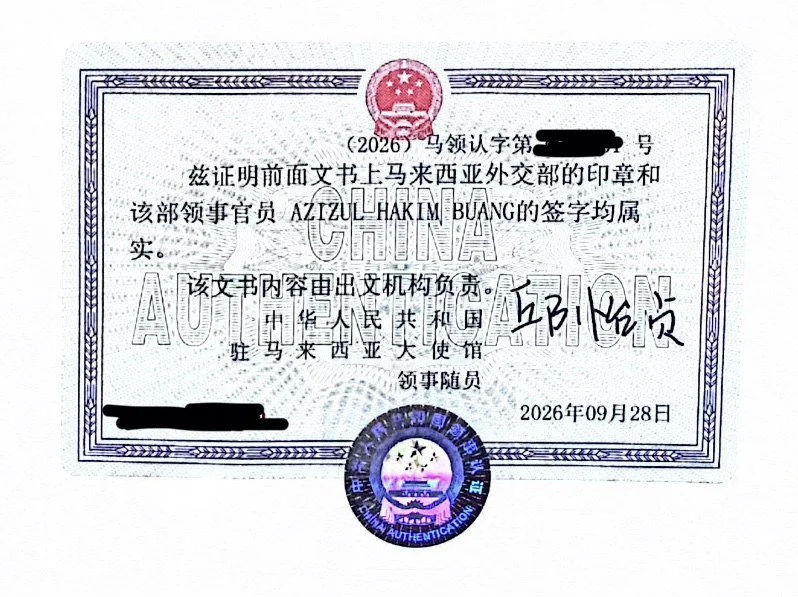
After Wisma Putra, the Chinese Embassy in Kuala Lumpur attaches an authentication certificate like the one below (from a document we handled in September 2026, reference number hidden). In Chinese, it confirms that the seal of Malaysia's Ministry of Foreign Affairs and the signature of its consular officer are genuine ("马来西亚外交部的印章和该部领事官员…的签字均属实"), and that the issuing authority remains responsible for the content ("该文书内容由出文机构负责"). It carries a reference number in the form (2026)马领认字第…号 and a "China Authentication" hologram. China joined the Apostille Convention in November 2023, but Malaysia has not, so Malaysian documents still need this certificate.
中文简介
马来西亚文件在中国使用
准备文件原件;私人文件(如授权书、声明书)须先由公证人公证。
将文件翻译成中文,由认证翻译员签名盖章。
在马来西亚外交部(Wisma Putra)办理认证。
在中国驻马来西亚使领馆或中国签证中心办理领事认证。
经验提示:使馆会询问认证用途,并可能要求提供相关证明文件,例如遗产继承案件可能需要提供相关房产的房地产权证。这些证明文件本身无需认证。
中国文件在马来西亚使用
中国签发的出生医学证明、结婚证、学历证书等文件,如需提交给马来西亚国民登记局(JPN)或移民局,通常须先在中国办理公证,并经中国外交部或地方外事办公室领事认证,再由马来西亚驻华使领馆认证,然后附上马来文或英文的认证翻译。马来西亚不是海牙认证(Apostille)公约成员国,仅有附加证明书(Apostille)并不足够。
具体要求因机构而异,请先向接收文件的机构确认。MYLegalTrans提供中文、英文和马来文认证翻译,并协助办理公证和文件认证。通过WhatsApp联系我们(+60 17-227 9378)