
Legalising Malaysian Documents for Spain
Short answer: Spain requires foreign public documents to be legalised first by the issuing country's foreign ministry and then by the Spanish embassy that covers it. For Malaysia, that means Wisma Putra (Malaysia's Ministry of Foreign Affairs), then the Embassy of Spain in Kuala Lumpur. There is no further step in Madrid for the document itself. The legalisation does not expire, though it cannot keep an expired document valid.
We take your documents through both steps: notarisation where needed, Wisma Putra attestation and the Spanish Embassy. Send your document on WhatsApp for a quote.
Last reviewed: October 2026. For translation rules, see sworn Spanish translation of Malaysian documents.
Step by step
Use the original. Spain legalises only originals or authentic copies with a handwritten signature: "No se legalizan ni fotocopias ni documentos plastificados" (no photocopies or laminated documents), and electronic signatures are not recognised.
Notarise private documents first, such as powers of attorney and declarations.
Attest the document at Wisma Putra. It is walk-in and returns documents the same day or the next working day.
Legalise it at the Embassy of Spain in Kuala Lumpur. The embassy recommends emailing the consular office before you go (emb.kualalumpur.sc@maec.es). Legalisations are handled Monday to Thursday, 9 am to 12 pm; notarial services need an appointment. A fee applies; the embassy does not publish it, so confirm by email.
Get a Spanish translation. See sworn Spanish translation for which translations Spanish offices accept.
The embassy's legalisation confirms the signature and seal, not the content of the document. "Legalized or apostilled photocopies cannot replace the original document."
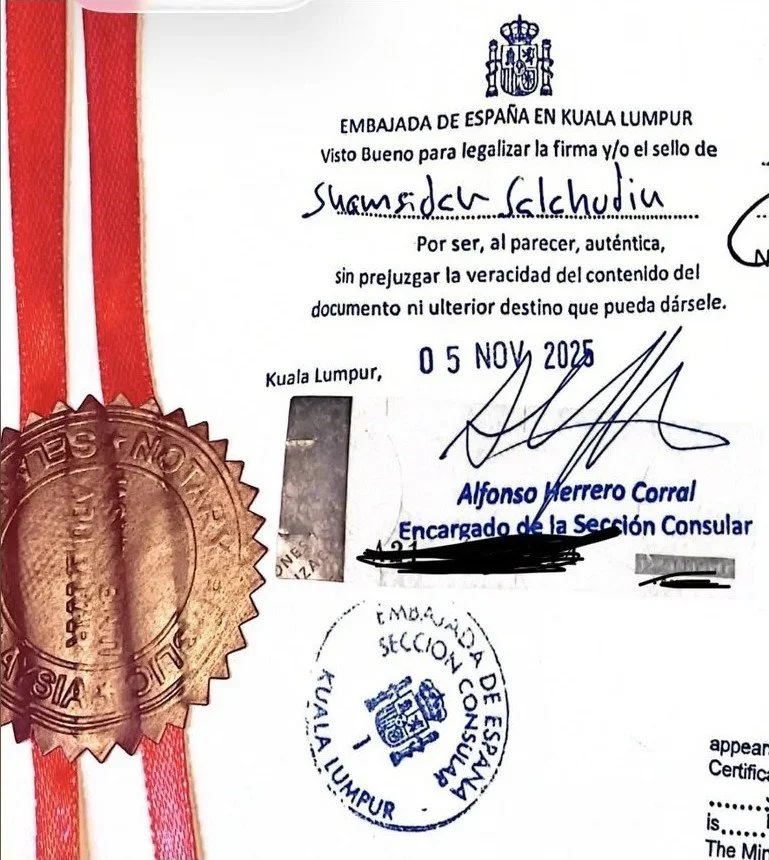
What the Spanish Embassy's visto bueno looks like
The Embassy of Spain in Kuala Lumpur stamps a "Visto Bueno para legalizar la firma y/o el sello de" the Wisma Putra officer who attested the document, "por ser, al parecer, auténtica" (because it appears genuine), without judging the truth of the content. It is dated, signed by the head of the consular section and stamped with the embassy's consular seal. This example, on a notarised document, is dated 5 November 2025; reference numbers are blacked out.
What gets documents refused
Photocopies, including certified photocopies, where an original is required.
Laminated documents.
Documents signed only electronically.
A missing Wisma Putra stamp.
Visas and residence
Visa applications at the embassy need legalised documents "together with an official translation into Spanish", and an appointment. In Spain, immigration offices (extranjería) also require a Spanish translation of every foreign public document; see which translations they accept.
Spanish documents for use in Malaysia
Malaysia does not recognise apostilles, and the Spanish Embassy in Kuala Lumpur "does not legalize or apostille documents issued in Spain". A Spanish document is first certified according to its type (civil-registry and court documents by the regional High Court or the Ministry of Justice, notarial documents by the notarial college, ministry documents by the issuing ministry), then legalised free of charge by the Legalisation Service of Spain's Ministry of Foreign Affairs, and then by the Embassy of Malaysia in Madrid. Malaysian agencies also need an English or Malay translation by a translator Wisma Putra accepts.
Información en español
Los documentos públicos malasios para España se legalizan primero en el Ministerio de Asuntos Exteriores de Malasia (Wisma Putra) y después en la Embajada de España en Kuala Lumpur. No se legalizan fotocopias, documentos plastificados ni firmas electrónicas. Conviene escribir a la embajada antes de acudir (emb.kualalumpur.sc@maec.es); las legalizaciones se atienden de lunes a jueves, de 9:00 a 12:00. Después, el documento necesita una traducción al español aceptada por la autoridad española.
Los documentos españoles para Malasia necesitan el reconocimiento previo que corresponda, la legalización gratuita del Servicio de Legalizaciones del Ministerio de Asuntos Exteriores y, por último, la de la Embajada de Malasia en Madrid. Malasia no reconoce la apostilla. ¿Tiene dudas? Escríbanos por WhatsApp (+60 17-227 9378).
Common questions
Does Spain accept an apostille from Malaysia?
Malaysia does not issue apostilles, so Malaysian documents are legalised through Wisma Putra and the Spanish Embassy instead. See apostille in Malaysia.
Does the legalisation expire?
No. But if the document itself has a limited validity, such as a police certificate, the legalisation does not extend it.
Do I need another stamp in Madrid?
Not for the Malaysian document. Only translations made by Spanish embassies or consulates need a further legalisation by the Ministry in Madrid.
Related guides
Sources: